
Products
Electronics Sourcing China: LED Displays, Screens and Devices
Our electronics sourcing China service covers LED displays and light boxes, consumer electronics, and portable smart screens and display equipment, researched with independent suppliers in China for each project.
- Display manufacturers visited in person
- Specifications verified per project
- Compliance reviewed with suppliers
This Division
What this division covers
The purpose of this division is to help international buyers identify suitable electronics suppliers, compare quotations on a like-for-like basis, and coordinate samples, production and shipping under an agreed scope. Electronics reward careful sourcing more than most categories, because two products that look the same in a photo can use very different components inside.
LED displays and light boxes
LED display panels and light boxes for signage, retail and presentation use. Display and signage manufacturers have been visited in person, so supplier capability can be discussed from direct observation, not only from a listing.
Consumer electronics
Consumer electronics products researched against the functional requirements you supply, subject to supplier availability, MOQ and the certification your market requires.
Portable smart screens and display equipment
Portable smart screens and related display equipment, sourced to the size, connectivity and use case described in your brief.
Why China
Why electronics are sourced from Guangdong
A large share of the world's electronics and display manufacturing is concentrated in Guangdong province, especially around Shenzhen, Dongguan and Guangzhou. Component suppliers, assembly factories, testing labs and export logistics sit close together, which shortens lead times and makes it easier to source parts for custom products.
That concentration also means many suppliers offer similar-looking products at very different quality levels. Some assemble from high-grade components with proper testing; others cut costs on power supplies, LED chips or batteries. Telling them apart is the main job of supplier research in this category.
Your Brief
What electronics sourcing China buyers should specify
Clear requirements produce comparable quotations. The items below are requirements you supply; they are not product specifications published by VECTA GLOBAL.
- Product type and intended use: for example indoor signage, outdoor display, retail light box or portable presentation screen
- Size: screen or panel dimensions and, for light boxes, the display area required
- Resolution and brightness where relevant to viewing distance and lighting conditions
- Connectivity and power: inputs, wireless needs, voltage and plug type for your market
- Target quantity, packaging and labelling, including any private-label branding
- Destination country and port, plus certification requirements in your market
If you have a reference product, send a link or photos. It is the fastest way for suppliers to understand the level of quality and features you expect.
Display Terms
Key display specifications explained
Display quotes are full of technical terms. These are the ones that most affect price and performance:
| Term | What it means | Why it matters |
|---|---|---|
| Pixel pitch | Distance between LED pixels, usually in millimetres | Smaller pitch gives a sharper image at short viewing distances but costs more |
| Brightness | Light output, often quoted in nits | Outdoor and window displays need much higher brightness than indoor ones |
| Ingress protection (IP) rating | Resistance to dust and water | Outdoor units need a suitable rating for rain and dust |
| Refresh rate | How often the image is redrawn each second | Low rates can flicker on camera or video |
| Cabinet or frame | The housing that holds modules or the light box face | Affects weight, installation, heat management and durability |
We ask every supplier to quote the same values for these terms, so a cheaper quote cannot hide a lower brightness or a weaker frame.
Light Boxes
Sourcing light boxes and signage
Light boxes look simple but vary widely. Key choices include the frame material and profile depth, single or double-sided display, fabric or acrylic face, edge-lit or back-lit LEDs, and how graphics are changed. For retail use, the evenness of light across the face and the ease of changing graphics are often what customers notice most. We confirm these details in the specification before sampling.
Compliance
Electronics sourcing China: certification and compliance
Electrical and electronic products are among the most regulated goods in international trade. Requirements depend on the product and the destination, and they must be confirmed before production, not after goods arrive. Common examples include:
- United States: many electronic devices need equipment authorization under FCC rules before sale
- European Union and United Kingdom: CE or UKCA marking for applicable safety and electromagnetic compatibility rules
- Saudi Arabia: conformity certification through the SABER platform for many regulated products
- Gulf markets: some low-voltage electrical products need Gulf conformity marking
In electronics sourcing China projects, the supplier's certificates and test reports are reviewed against the requirements you give us: the right product, the right company name and a valid date. Compliance is reviewed with the supplier but not certified by VECTA GLOBAL, and laboratory testing can be arranged as separate scope.
Batteries
Products with batteries
Many consumer electronics and portable screens contain lithium batteries. These are classed as dangerous goods for transport, so suppliers usually need to provide battery test documentation, often a UN 38.3 test summary, and a safety data sheet before forwarders will accept the cargo. Air freight rules for batteries are stricter than sea freight.
We ask for battery documents during supplier research, not at the shipping stage, because a supplier that cannot provide them can block an entire shipment.
Testing
What to test in electronics samples
- Power on and run the product for an extended period, not just a few minutes
- Check brightness and colour evenness on displays across the whole surface
- Test every input, button, connection and wireless function you need
- Check charging, battery life and heat on battery-powered products
- Inspect cables, adapters and plugs for your market's voltage and socket type
- Review the manual, labels and packaging in the languages you need
Many electronics faults only appear after hours of use. Factories that run ageing or burn-in tests before packing generally deliver more reliable goods, and we ask about these tests during supplier screening.

Inspection
What electronics inspections check
| Check | What it covers |
|---|---|
| Function test | Every unit in the sample powered on and operated, including inputs and controls |
| Display quality | Dead pixels, colour shifts, uneven brightness, scratches on panels or faces |
| Safety basics | Plugs, cables and adapters correct for the market; labels and ratings present |
| Workmanship | Frame finish, gaps, loose parts and screw fittings |
| Accessories | Remotes, mounts, cables and manuals included and correct |
| Packing | Foam or inner protection, carton strength and carton marking for fragile goods |
Criteria and AQL limits are agreed before production. See Quality Inspection for how inspections are planned and reported.
Avoid These
Common mistakes in electronics sourcing
Most problems in electronics sourcing China buyers face come from a few avoidable mistakes:
- Comparing on price alone. Cheaper units often use lower-grade power supplies, LED chips or batteries.
- Assuming certificates are valid. Check the product, company name and date on every report.
- Ignoring the plug and voltage. A product built for one market may not be usable in another.
- Short sample tests. Faults often appear only after hours of use.
- Weak export packing. Displays and screens are fragile and need proper inner protection.
Shipping
Shipping displays and electronics
Large displays and light boxes are bulky and fragile, so packing method and carton strength matter as much as freight cost. Wooden crates are often used for large display cabinets. Smaller electronics travel well by sea in cartons, while urgent or high-value items may go by air, subject to battery rules. We compare forwarder options on the same basis and coordinate documents with the supplier. See Shipping Coordination.
Private Label
Branded electronics and displays
Many buyers want displays or devices under their own brand. Common options include a logo on the frame or housing, a custom boot screen, branded packaging and manuals, and custom colours. Each option affects MOQ and cost, and some need tooling. We confirm these choices on the pre-production sample. See OEM & Private Label for how branded projects run.
Process
How an electronics enquiry proceeds
1. Send your requirements
Product type, size, resolution or brightness needs, quantity and destination, through the quote request.
2. Suppliers researched
Suitable independent suppliers are researched, checked and asked to quote on like-for-like specifications, including certification documents.
3. Samples and confirmation
Samples are arranged and tested, specifications are confirmed in writing, and the order proceeds only under agreed terms.
4. Production, inspection and shipping
Production is followed, goods are inspected against the approved sample where agreed, and shipping is coordinated. See How It Works.
Smart Screens
Portable smart screens: what to specify
Portable smart screens combine a display, a computer and often a battery in one unit, so they need more detail in the brief than a simple monitor. Useful points to define include screen size and resolution, touch or non-touch, the operating system and app support you need, battery life and charging, the stand or mounting method, speakers and camera, and wireless connections. Tell us how the screen will be used, for example in retail, events or meetings, so suppliers can propose suitable models rather than generic ones.
Quality Points
Where electronics quality differs
- Power supply: a common cost-cutting area and a frequent cause of failures
- LED chips and panels: grade affects brightness, colour consistency and lifespan
- Batteries: cell quality and protection circuits affect safety and life
- Solder and assembly: poor workmanship shows up as intermittent faults
- Heat management: enclosed designs need proper cooling to last
Asking each supplier which components it uses, and confirming them on the approved sample, is the best protection against quiet downgrades in bulk production.
After Sale
Warranty and spare parts
Before ordering, agree what happens if units fail after delivery. Useful points to settle in writing are the warranty period the supplier offers, whether spare parts such as modules, power supplies or remotes can be supplied with the order, and how replacement units are handled. For displays in particular, ordering a small number of spare modules with the main order is common practice and saves long waits later.
Price Drivers
What drives electronics prices
Electronics prices move with component costs, especially for chips, panels and batteries, so quotations usually have a short validity period. Beyond components, the biggest price drivers are size, brightness and resolution for displays, battery capacity for portable devices, certification and testing for your market, customisation, and packaging for fragile goods.
When we compare quotations, each of these is listed separately. That shows where a low price comes from: a genuine saving, or a cheaper component that may cost more in returns later.
Installation
Installation and project buyers
Project buyers sourcing displays for a specific site often need more than the units themselves: mounting structures, control systems, cables of the right length and installation drawings. These should be listed in the brief so suppliers quote the complete package. If installation will be done locally, ask for clear manuals and wiring diagrams in your language with the order.
Factory Visits
What we look for at a display factory
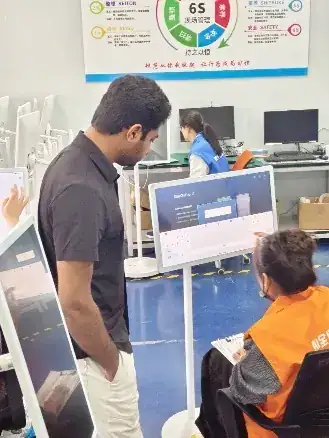
During in-person visits, we look at how modules and panels are assembled, whether units are aged or tested before packing, how colour and brightness are calibrated, what the incoming component checks look like, and how fragile goods are crated for export. These observations, rather than brochure claims, are what we use to compare display suppliers for your project.
Limitations
Limitations: VECTA GLOBAL does not own factories, and compliance with your market's regulatory requirements is reviewed per project with the supplier; it is not certified by VECTA. Typical deliverables include a supplier shortlist, quotation comparisons, sample arrangement and procurement milestone updates, depending on what is agreed for your project.
FAQ
Frequently asked questions
Have you visited display factories?
Yes. Display and signage manufacturers are among the factories visited in person by our founder.
Can you source outdoor LED displays?
Yes, subject to supplier availability. Specify the viewing distance, size, brightness and the weather conditions the display must handle.
Do you check certificates?
We review supplier certificates and test reports against the requirements you give us, and can arrange independent laboratory testing as separate scope.
Can products with batteries be shipped?
Yes, with the right documents. Battery test summaries and safety data sheets are requested from suppliers early.
What is the MOQ for displays?
It depends on the supplier and on customisation. MOQs are confirmed in the quotation comparison before you commit.
Ready to discuss your project?
Send your display or device requirements and we will reply with next steps for your electronics sourcing China project.