
Blog · Supplier Verification
Factory vs Trading Company China: What B2B Buyers Should Know
A supplier can be a manufacturer, a trading company or a mix of both. This guide to the factory vs trading company China question shows how to tell them apart, and when each one is the better choice.
Many buyers start with the same question: is this a real factory? The more practical question is: what role does this company actually play in making and supplying your product, and can you verify that role in writing?
A factory manufactures goods itself, in its own facility, with its own equipment and workers. A trading company sources goods from one or more factories and resells them to you. Some companies do both, they manufacture a core range and trade other products alongside it. Problems start when a company claims one role and performs another, because your checks, contract and expectations are then based on the wrong picture.
Factory vs trading company China: why it matters
Pricing layers
Buying from a factory normally means paying the manufacturer directly. Buying through a trading company adds a layer: the factory price plus the trading company’s margin. That margin is not automatically wasted money, it may pay for sourcing, communication, consolidation and follow-up you would otherwise do yourself. What matters is knowing the layer exists, so you can judge whether it is justified.
Accountability
A factory controls its production line, so it can answer directly about materials, process and scheduling. A trading company must go back to its factory, which can slow answers and blur responsibility unless the contract states clearly who is responsible for what. Neither arrangement removes risk, but you need to know who you can hold to the agreed specification.
Capability
A factory’s capability is limited to what its equipment and experience allow, a strength for products it makes regularly, a limit outside that range. A trading company may offer a wider range, but its technical knowledge of a single product may be shallower.
Check the business licence and registered name
Ask for the business licence and note the full registered name, in Chinese where available, the registered address, and the licensed business scope. The scope is informative: a manufacturer will normally list production activities for a defined product area, while a trading company will typically list sales, import and export, or wholesale activities.
The licence confirms a company is registered and what it is registered to do. It does not prove it makes your product well. Treat it as a first filter, then check it against everything else, quotation, contract, invoice and bank details should all point to the same legal entity. If names differ, ask for the reason in writing before any payment. A broad registered scope does not mean the company manufactures everything it lists.
Confirm whether the entity makes or resells the product
Ask directly: do you manufacture this product yourselves, or do you source it from another factory? A straightforward supplier will answer plainly. Follow up for the claimed role:
- If it claims to be the factory: where is the production site, what equipment is used for this product, and which stages are in-house versus outsourced?
- If it is a trading company: which factory will produce the order, where is it, and can that relationship be confirmed?
- If it does both: which role applies to your specific product and order?
Check the product range: a supplier presenting itself as a specialist factory while offering many unrelated products is usually trading at least part of that range. That does not disqualify it, but its role for your order should be stated honestly.
Use a factory visit or a live-video walk-through
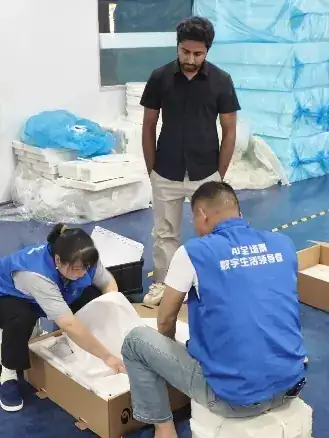
Seeing production is more informative than documents alone. If a visit is practical, look for the product, or products like it, being made: raw materials, work in progress, finished goods, packing, and a quality-check process. Note whether signage, equipment and scale match what was described.
If you cannot visit, a live-video walk-through at an agreed time is the next option. Ask to see the entrance and company name, the production area for your category, the packing area, and specific equipment named earlier. A live walk-through is harder to stage than a pre-recorded video, because you can ask the person filming to show details in real time. One visit shows that day only; it does not replace a written specification, sample approval, or inspection where justified.
Check consistency across contract, invoice and payment
- The registered name on the licence, the name on the quotation and proforma invoice, and the name on the contract.
- The bank account name receiving payment, it should match the contracting company, or any difference should be explained and documented.
- The addresses for factory, office and contract, these may legitimately differ, but you should know which is which.
- Who signs the contract, and whether that person represents the company named in it.
A trading company contracting and receiving payment in its own name is operating normally. A mismatch with no clear explanation is a reason to pause, not to proceed and hope it resolves itself.
Ask technical questions about production
Ask how the product is made, which materials are critical, where tolerances matter, what commonly goes wrong, and how defects are handled. Ask what drives the minimum order quantity and lead time.
A manufacturer working with the product daily can usually answer in concrete process terms. A trading company may need to consult its factory, acceptable, if you eventually receive specific, consistent answers matching the sample and specification. Answers that never become specific are a warning sign.
When a trading company is the right choice
A trading company is sometimes the better fit, and a factory is not automatically better:
- Small quantities: a factory minimum may be higher than you need, while a trading company may offer a route to smaller runs, depending on the product.
- Multi-product orders: a trading company can consolidate products from several factories into one shipment, which a single factory cannot do for products it does not make.
- Export experience: some trading companies handle export documentation, packing requirements and communication in your language more routinely than a factory focused on domestic production.
Direct factory buying can also mean stricter minimums, less flexible communication, and more coordination work falling on you. The right choice depends on your product, quantity, timeline and capacity to manage the order.
What to confirm in writing either way
- The supplier’s role for this order, and, if trading, the location and type of the producing factory, where disclosure is agreed.
- The full specification, materials, dimensions and packaging, as the basis for production and any inspection.
- Price, currency, Incoterms, payment schedule and the exact bank account name for payment.
- Lead time, what it covers, and what happens if production or shipment is delayed.
- How defects, shortages or non-conforming goods will be handled.
How VECTA GLOBAL approaches this
We identify the supplier’s actual role and tell the buyer. We do not present a trading company as a factory, and we do not present independent factories as our own, VECTA GLOBAL does not own factories. As part of supplier evaluation, we check registration details, clarify whether the entity manufactures or resells the product, and report what we could and could not confirm. See our Supplier Research & Evaluation page and our guide to evaluating a Chinese supplier.
Side-by-side comparison
This table summarises the factory vs trading company China question on the points buyers care about most. It describes typical patterns, not rules; individual suppliers vary.
| Point | Factory | Trading company |
|---|---|---|
| Price | Closer to production cost | Includes a margin for the trader |
| MOQ | Often higher, especially for custom work | Can be lower by combining orders |
| Product range | Focused on what the factory makes | Wide, across many factories |
| Technical answers | From the people who make the product | Passed on from the factory, which can slow changes |
| Control over production | Direct | Indirect, through the trader's relationship |
| Export handling | Varies; some factories export well, others do not | Often strong, as exporting is their core work |
| Accountability | The maker is responsible | The seller is responsible under your contract |
Hybrid suppliers
Many suppliers sit between the two. A factory may make some products itself and buy others in to offer a fuller range. A trading company may own a small workshop for one product line. Ask the supplier directly which of your items it makes in-house and which it sources from other factories, and check the business scope on its licence against the official record in the National Enterprise Credit Information Publicity System.
Signals that suggest which one you are dealing with
| Signal | Leans factory | Leans trader |
|---|---|---|
| Business scope | Includes production or manufacturing | Mainly trade, import and export |
| Product range | Narrow and deep | Very wide, across unrelated products |
| Factory tour | Shows lines, materials and staff on your product | Avoids the line, or shows a showroom only |
| Technical questions | Answered quickly and in detail | Answered later, after checking with someone else |
| Address | Industrial zone, matches the factory | Office building, far from any factory |
No single signal is proof. Several pointing the same way give you a reliable picture, and in the factory vs trading company China decision, a clear picture is what matters most.
Working well with a trading company
If you choose a trading company, a few habits keep the relationship transparent. Ask which factory makes your product and whether you can see it, at least on video. Make sure the contract names the trading company as the seller and sets out quality requirements, inspection rights and remedies. Ask the trader to confirm in writing that the production site will not change without your approval.
A good trading company will accept these points easily, because they are standard good practice. Reluctance on any of them is worth noting.
Custom and OEM products
For custom or branded products, working close to the factory matters more. Tooling, materials, tolerances and packaging changes all need clear technical communication, and every layer between you and the production line adds room for misunderstanding. Many buyers start with a trading company for stock items and move to direct factory relationships once they develop their own products. When tooling is involved, confirm in writing who owns the moulds, whichever type of supplier you use.
Factory vs trading company China: the decision in practice
- Choose a factory when you need technical control, custom work, the lowest realistic price at volume, or a long-term single-product relationship
- Choose a trading company when you need a wide range, lower MOQs, simpler export handling, or one counterparty for several products
- Either can work for stock products, as long as you know which one you are dealing with and the contract reflects it
Whichever you choose, the checks are the same: verify identity, see the production, approve a sample in writing, and inspect before the balance.
Quick answers
Are trading companies more expensive?
Usually a little on unit price, but lower MOQs and simpler logistics can make the total cost similar or lower for small orders.
Can a factory refuse small orders?
Yes. Many factories set minimums that suit their production lines. A trader may be able to meet a lower quantity.
Is it dishonest for a trader to call itself a factory?
It is misleading. Ask directly and check the records; an honest trader will explain its role clearly.
Can I switch from a trader to the factory later?
Sometimes, but check your agreement first. Some traders include terms about direct contact with their suppliers. Being open about your plans from the start avoids disputes later.
Does a factory visit settle the question?
It usually helps a lot, but make sure the visit shows your product being made, not just a showroom or a partner's facility.
In short, the label matters less than the facts behind it. Know who makes your product, who sells it to you, and who is responsible if it is wrong, and you can work safely with either type of supplier for years.
Not sure what type of supplier you are dealing with?
Not sure who you are dealing with? Send us the supplier details and we will help with your factory vs trading company China check.